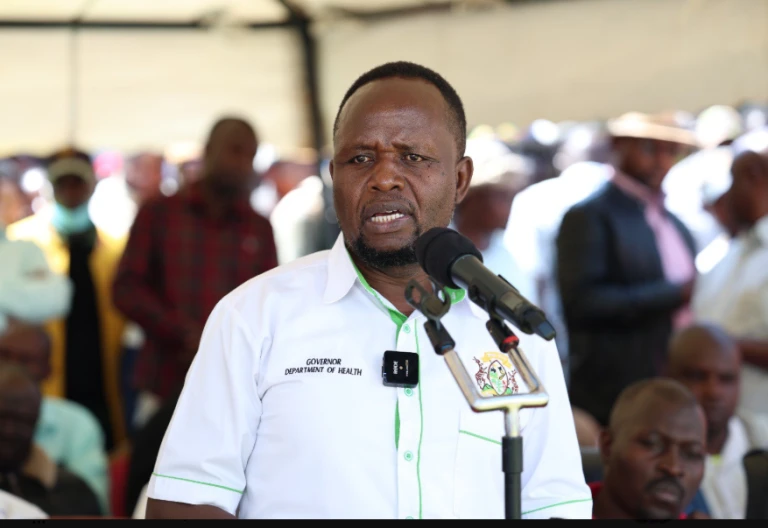
Trans Nzoia Governor George Natembeya has challenged President William Ruto over plans to open a market in the county, arguing that the county government and World Bank financed the project.
People Daily reported that Natembeya made the remarks on Saturday, 10 October, after Ruto said he would return to launch the market. The governor objected to the national leadership claiming credit for work he attributed to county-led investment.
Ruto, meanwhile, accused the governor’s opposition politics of obstructing development during an address in Endebess. He pledged investment in services and infrastructure.
The exchange sets two political accounts against each other. Natembeya’s funding claim should be tested against project agreements, procurement records and payment documents; a launch ceremony alone does not establish who financed construction.
For market traders, the practical questions are when the facility becomes usable, how spaces are allocated and who is responsible for its operation.
Political Headache analysis: follow the project, not the podium
A dispute over who opens a market can obscure the people who will use it every day. Traders need an operational facility, affordable terms and predictable management. Political credit matters to leaders, but the quality of those arrangements will determine whether the investment improves the working day of the people it is meant to serve.
There are several different roles in any project: identifying the need, obtaining finance, procuring construction, supervising delivery and operating the finished facility. They need not belong to one institution. A useful account would identify each role rather than force the entire history into a choice between two politicians.
Natembeya's claim about county and World Bank funding is therefore a starting point for document-based reporting. It should be possible to compare that account with the relevant financing agreement and project records. The identity of the guest at an opening ceremony would answer a different question about political visibility.
What the documents would clarify
The original project description would help establish the intended scope. Contract and completion records would then show whether the facility delivered matches that scope. Payment information could clarify which institution paid for which component and whether any outstanding obligations remain. None of those details should be inferred solely from a speech.
Where more than one source of funding is involved, a breakdown would be more useful than a single headline figure. It could distinguish construction from equipment, access works and later maintenance. That would allow readers to recognise contributions accurately without assuming that every activity at the site came from the same budget.
This approach is fair to both national and county officials. It gives either side an opportunity to substantiate its account and reduces the space for competing claims to become accepted history simply through repetition. It also makes corrections possible if the initial political description turns out to be incomplete.
The trader's test
For intended users, allocation is a central question. They need to know how spaces will be offered, what eligibility criteria apply and how complaints will be handled. A building can be physically complete while the arrangements for occupying it remain unclear. A public opening date should therefore be accompanied by practical information.
Operating costs deserve the same attention as construction. Cleaning, security, water, waste management and repairs need a responsible manager and a source of income. If those arrangements are not clear, the facility may disappoint even when the building itself is sound. This is a general test of project readiness, not a finding about conditions at this market.
Traders should also be able to understand any move from existing trading locations. Clear notice and communication would help them plan around disruption and compare the terms offered. Their experiences after occupation would provide evidence that is missing from a dispute conducted mainly through political statements.
Development amid political disagreement
Ruto and Natembeya can disagree over national politics while public institutions still have identifiable responsibilities to residents. A stronger public debate would ask whether those responsibilities are being carried out and where cooperation is needed. Political loyalty alone cannot show whether a market is complete, accessible or well managed.
The next useful development would therefore be an operational plan and a documentary account of financing. Together, those would answer both the argument over credit and the question of service to traders. Until they are examined, claims about ownership of the achievement should remain clearly attributed to the leaders making them.
Photo details
WHAT TO WATCH NEXT
- Publication of the market’s financing and implementation records.
- Opening arrangements and allocation of trading spaces.