
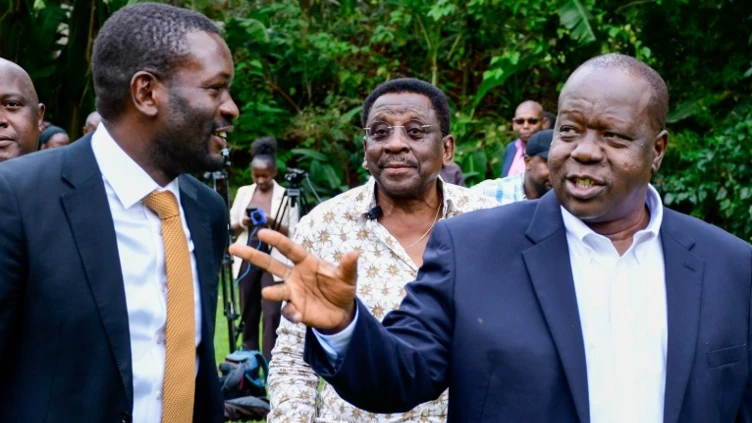
Nairobi Senator Edwin Sifuna has invoked the constitutional right to information in his dispute with President William Ruto over the Dangote refinery agreement, keeping scrutiny of the proposed Lamu investment in the political spotlight after its groundbreaking. His 2 October intervention followed Ruto’s instruction that lawmakers should use parliamentary procedures to obtain the document.
The disagreement is about disclosure and the government’s commitments, not evidence that the refinery is already producing fuel. The official description remains a proposed industrial project. A ceremony, construction equipment and political endorsements do not establish the terms of the agreement being contested.
In People Daily’s account of his 2 October statement, Sifuna argued that important state information should be disclosed as a constitutional obligation. He had previously questioned whether legislators knew the commitments Kenya had made and raised the concerns of residents pursuing court action.
Ruto points to parliamentary procedures
Speaking in Mombasa on 1 October, Ruto said the agreement could be sought through Parliament and disputes involving the investor pursued in court, according to People Daily’s report of his response.
“Hiyo agreement, kama unataka unajua vile agreement inaulizwa kule bungeni ndiyo iletwe,” Ruto said in the published account. He also accused critics of trying to pressure the investor. That accusation is the President’s position, not an independently established explanation of why every critic is seeking information.
The two positions leave an important practical question unresolved in the material reviewed: when will the agreement itself be accessible? A statement that a document can be requested is different from the document being tabled. This newsroom has not verified a subsequent tabling or obtained the complete agreement.
What the government has put on record
The Transport Ministry’s account of the 30 September groundbreaking identifies a planned capacity of 700,000 barrels a day. It connects the project to Lamu Port and the LAPSSET transport corridor, presenting it as a source of industrial, logistics and employment opportunities.
The ministry also reports Aliko Dangote’s plan for an engineering training school in Lamu. It says he stated that more than 110 pieces of equipment were on site, with another 400 expected within 60 days. These are attributed construction and training plans; they should not be converted into a count of completed jobs or operating facilities.
Those details make the proposal more specific than a general investment pledge. They nevertheless concern planned capacity, mobilisation and skills development. They do not substitute for ownership information, financing terms or the obligations undertaken by public institutions.
The Defence Ministry’s separate account puts the estimated project value at approximately Sh2.2 trillion and describes the intended market as Kenya and the wider East African region. It confirms the ceremony’s date and the participation of Ruto and Dangote.
“This is an investment in energy security, industrialisation and regional integration,” Ruto said, according to that official account. The statement explains the government’s policy case for the project. It is not a financial disclosure or a guarantee that every projected benefit will materialise on schedule.
The information issue extends beyond one senator
Article 35, reproduced by Kenya Law, recognises citizens’ access to information held by the state and requires publication of important information affecting the nation. Kenya Law’s account also explains that the Access to Information Act contains limitations, including national-security and due-process considerations.
That framework does not allow this article to decide whether every clause of an unseen agreement must be released unchanged. It does establish why the dispute cannot be reduced to a personal disagreement between Ruto and Sifuna: access to state information is a constitutional issue affecting citizens as well as legislators.
Disclosure would allow separate questions to be examined against actual terms. Land contributions, infrastructure responsibilities, financing commitments and projected economic returns are not interchangeable. Without the underlying documents, an investment headline cannot resolve which institution bears a particular cost or obligation.
The political argument and the project are separate tests
Political Headache’s earlier report on regional support for the refinery distinguished endorsement from an investment commitment. The same distinction applies here: a defence of industrialisation does not answer every disclosure question, and a demand for documents does not establish that the project is unlawful.
The next decisive evidence would be the agreement, an official response to a documented request, or a relevant parliamentary or court record. Until then, the verified development is a continuing dispute over transparency, set against official descriptions of a major proposed investment. Neither side’s rhetoric should be presented as a finding about terms that have not been independently examined.
Photo details
WHAT TO WATCH NEXT
- The dispute centres on disclosure of commitments, while official accounts describe planned refinery capacity and construction mobilisation.
- Publication or parliamentary tabling of the refinery agreement and associated land arrangements.