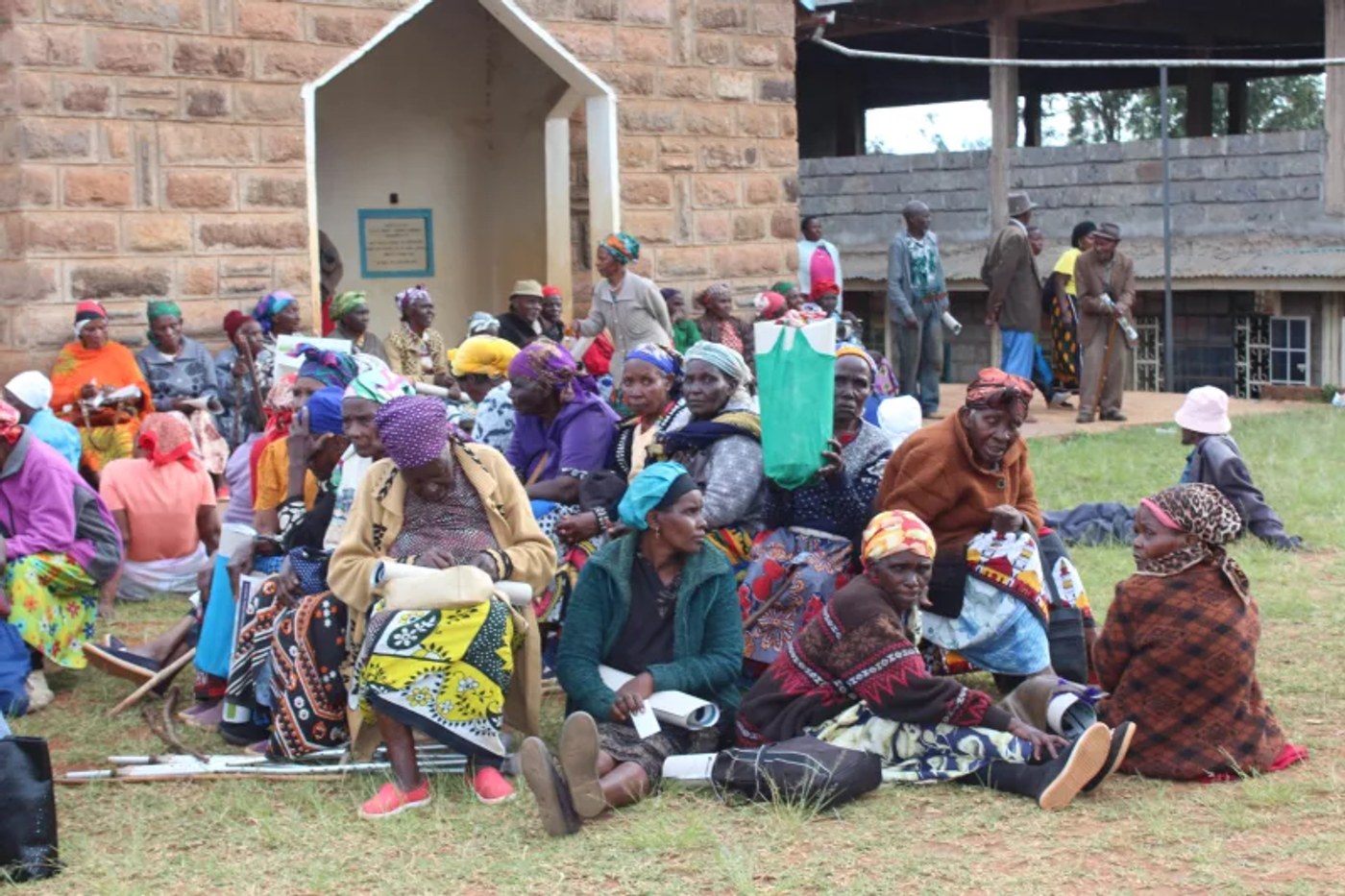
About 500 elderly residents turned up at Karung'e ACK Church in Mathioya, Murang'a County, to register for the Inua Jamii cash transfer programme. There was one registration machine.
The exercise took place on 2 October. By the end of the day only 60 to 70 people had been registered. One beneficiary waited from 7am to 5pm.
What Inua Jamii is
Inua Jamii is the government's main cash transfer programme for vulnerable people, including older persons and people with severe disabilities. Beneficiaries currently receive Sh2,000 a month.
In Mathioya, the programme targets about 7,000 beneficiaries, including about 170 persons with disabilities.
The exercise also included proof-of-life checks for people already enrolled, Deputy County Commissioner Riungu Laikera said. Those checks confirm that payments are going to living beneficiaries, a safeguard against fraud.
Why one machine fails
Registration requires capturing biometric data and verifying identity. Each person takes several minutes, and older people may need help with fingerprints that are worn or with documents.
With one machine, the maths does not work. If the target is 7,000 people and one machine handles about 70 a day, registration in Mathioya alone would take about 100 working days. That is a Political Headache calculation from the figures given on the day.
Resident Jeffrey Kuria said the exercise could not be completed with one machine and asked for at least three.
The human cost of a queue
For a frail 80-year-old, a ten-hour wait is not an inconvenience. It means a day without proper food, water or toilets, often after a long walk or a paid ride to the centre.
A local philanthropist, Kenneth Kabue, provided transport for some residents. That kindness also shows the gap: people should not depend on private help to reach a public service.
Some beneficiaries said the stipend does not cover their needs. One resident said the money is insufficient for medicines for chronic conditions. Kabue argued the stipend should rise to Sh5,000.
The official response
Laikera said registration teams would move to different locations to ease access and reduce congestion at a single centre.
Capacity can be measured simply. If each kit and operator can register about 70 people a day, three kits would cut Mathioya's timeline from about 100 working days to roughly 33, and five kits to about 20. Those are rough Political Headache estimates, but they show that the shortfall is a matter of equipment and staff, which the State Department for Social Protection can fix with a procurement and deployment decision rather than a change in policy.
Spreading teams is sensible. But moving one machine around does not increase the number of people registered per day. Unless more kits and staff are deployed, the total time needed stays the same.
The registration rate in Mathioya also raises a fairness issue. Those who arrive first or have help with transport get registered; those who are frailest or live furthest away may give up. A system that depends on queue endurance selects against the most vulnerable.
Booking systems, where each village is given a specific day and time, and home visits for bedridden beneficiaries, are common solutions elsewhere. Officials did not say whether either will be used in Mathioya.
A national pattern
Social protection programmes have gone through several changes in registration and payment systems in recent years, including the move to digital payments and the Enhanced Single Registry.
Each change requires beneficiaries to verify again. Where the state does not put enough kits in the field, the burden falls on the people least able to bear it.
The government has also been promoting a wider social protection agenda, including the national school-meals plan announced at the Social Protection Conference in late September. Delivery of existing programmes like Inua Jamii is the test of that agenda's credibility.
Members of Parliament and county assembly members for Mathioya can also press the issue. The National Government Constituencies Development Fund and county governments sometimes support transport for older persons, and MPs can ask the ministry in Parliament for registration timelines and kit numbers.
The persons with disabilities among the target group need particular attention. Registration sites should be accessible, with seating, shade and priority service for those who cannot stand for long.
What beneficiaries can do
Older persons or their families should ask the area chief or the sub-county social development office for the registration schedule in their location, so they do not travel on a day when their area is not covered.
Anyone whose payments stop after a proof-of-life exercise should ask the social development office to confirm their status. Errors in verification can cut off payments to people who are alive and eligible.
Payment delays are a related complaint in many areas. Beneficiaries who are not verified in time can miss payment cycles, and arrears may take months to clear. The ministry should say whether anyone in Mathioya will miss a payment because registration was not completed.
Families can help by preparing documents in advance. Having the beneficiary's national ID, any previous programme card and a working phone number ready can shorten the time at the registration desk, even if it cannot fix the shortage of machines.
What to watch
First, whether the State Department for Social Protection deploys more registration kits to Mathioya and similar areas.
Second, published figures on how many people have been registered and verified nationally in this round, and how many remain.
Third, the stipend itself. Sh2,000 a month has not kept pace with prices. Any change would need to be budgeted, and should be watched in the next budget cycle.
Photo details
WHAT TO WATCH NEXT
- About 500 elderly people waited at one Inua Jamii registration machine in Mathioya, Murang'a; only 60–70 were registered that day.
- Mathioya targets about 7,000 beneficiaries; at that rate, registration would take roughly 100 working days (our calculation).
- Inua Jamii pays Sh2,000 a month; the exercise includes proof-of-life checks.
- Officials say teams will move between locations; residents asked for more machines.