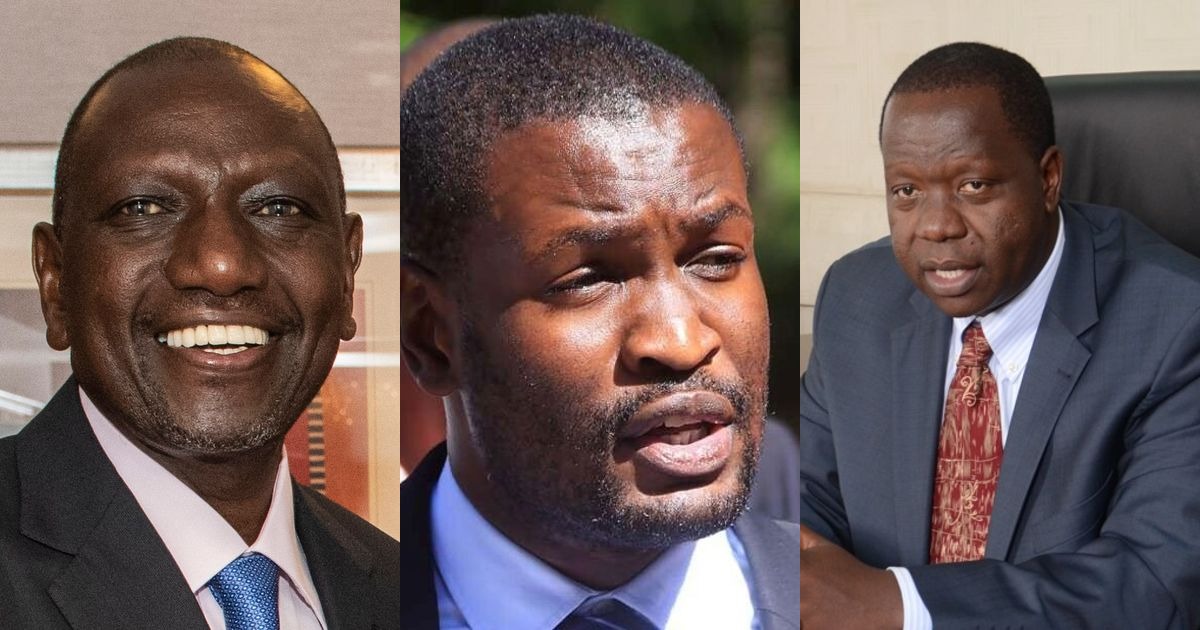
Kenya's opposition appears to have found itself in a rather peculiar disagreement over how to defeat a president they all agree must go. On Sunday, 1 November, 2026, former Interior Cabinet Secretary Dr. Fred Matiang'i took issue with former Deputy President Rigathi Gachagua's approach to opposition politics, warning that his "majoritarian arrogance" threatened to divide the coalition seeking victory in 2027. Matiang'i rejected the ethnic balkanisation of Kenya into political enclaves, insisting that competence, character and qualifications ought to determine who leads. Gachagua's response two days later was characteristically unapologetic: he was not being arrogant, merely truthful. Elections were a game of numbers, and Ruto would hardly be defeated by press conferences, boardroom negotiations and declarations of goodwill.
Matiang'i's argument was straightforward. Kenya's next president should be selected on the strength of what they could offer the country, rather than the community from which they hailed. His proposition of "one term plus positive change" sought to distinguish the pursuit of the presidency from the pursuit of power for its own sake. After all, if the opposition's only objection to Ruto is that he occupies State House, and anybody else would do, then perhaps its problem is less with how he governs than with who gets to govern. Matiang'i called instead for aspirants to present their policies, records and qualifications to Kenyans across the country, allowing citizens to make their own judgments.
Gachagua, however, was speaking to an equally uncomfortable reality. Elections are not won through eloquent arguments alone, however admirable the speeches. His proposal was for opposition principals to consolidate their respective regional strongholds, demonstrate their electoral strength and subsequently negotiate a common presidential candidate. Mount Kenya, Ukambani and Western Kenya would provide an initial foundation, with other regions brought into the arrangement. Far from excluding his colleagues, he argued, this division of labour would make campaigning more manageable. He also challenged them to match the political energy of an incumbent who traverses the country relentlessly. One cannot expect to defeat William Ruto without doing the difficult, expensive and often exhausting work of mobilising voters.
Neither man, however, is an entirely impartial advocate of his preferred political philosophy. Matiang'i's career spans the ICT, Education and Interior ministries, earning him a reputation as a formidable administrator and the unofficial title of former President Uhuru Kenyatta's "super CS". His record offers evidence of executive capacity, even if his exercise of state authority, particularly in the security docket, warrants serious scrutiny. Gachagua's political capital, meanwhile, rests considerably on his emergence as a leading powerbroker in Mount Kenya, a region with enormous electoral significance. Yet his own championing of a divisive, ethnically defined "shareholder" government was among the grounds upheld in his impeachment on 17 October, 2024. Naturally, Matiang'i emphasises capacity beyond numbers, while Gachagua emphasises the electoral weight of communities and their political representatives. While both may sincerely believe their arguments, they also stand to benefit from whichever frame prevails.
And Gachagua's arithmetic is not without constitutional foundation. Article 138(4) of the Constitution of Kenya, 2010 requires a presidential candidate to secure more than half the votes cast nationally and at least 25% of the votes cast in each of more than half of Kenya's 47 counties: at least 24. Geographic reach is therefore not optional. Yet the Constitution demands geographic reach without prescribing ethnically allocated ownership. There is a difference between mobilising voters within a region and presuming to deliver them to another politician. Coalition-building is necessary, particularly given the lessons of opposition fragmentation in 1992 and 1997 that failed to defeat then-President Daniel Arap Moi. The danger arises when regional kingpins start to undermine the agency of the citizens they are claiming to stand for. Ethnic mobilisation may be a practical instrument of electoral politics, but it remains a deeply inadequate vision of national leadership.
Perhaps nowhere is this dilemma more pronounced than among the generation whose political awakening came in June 2024. Rallying around the ideals of being tribeless, leaderless and partyless, young Kenyans challenged not only the Finance Bill but the political establishment's assumptions around organisation, participation and accountability. Admittedly, these ideals were hardly a comprehensive electoral blueprint. Nevertheless, the protests revealed an extraordinary appetite for a politics rooted in shared citizenship rather than inherited loyalties. For a fleeting, exhilarating moment, Kenyans appeared willing to imagine political participation on fundamentally different terms.
Fast-forward to November 2026, and many of those same young Kenyans are receiving a rather different political education. Coalition arithmetic, regional mobilisation, negotiated candidacies and electoral machinery have become the vocabulary of an approaching election. Some have embraced these realities enthusiastically; others have done so with considerably less appetite. There is maturity in recognising that ideals alone cannot deliver electoral victories. But there is danger in mistaking the conventions of our politics for its non-negotiable limitations. While political maturity is learning to navigate the country as it is, political resignation risks allowing the legacy we have inherited to extinguish the possibilities we once imagined. Political resolve, however, refuses to surrender the hope of change to the realities that will make it achievable.
I fear that in our increasingly desperate pursuit of William Ruto’s departure, we may progressively lower our expectations of what political change ought to deliver. His administration must answer for its own decisions, failures and the extraordinary disillusionment accompanying them. Yet corruption, patronage, institutional capture and ethnic political bargaining were hardly invented in September 2022. They preceded Ruto and will not obligingly follow him out of State House. If we make his removal both the beginning and end of our political imagination, we risk mistaking the departure of a president for the transformation of a country.
After all, we have been here before. In 2002, the refrain "Yote yawezekana bila Moi" captured the extraordinary optimism surrounding the end of Daniel Arap Moi's 24-year presidency and KANU's nearly four-decade hold on power. His departure ushered in genuine democratic progress, expanded political freedoms and, eventually, a new constitutional order. Yet some habits survived, and others became more pronounced. Ironically, Moi himself had warned that multiparty competition could aggravate ethnic divisions, even as his own administration contributed to ethnic mobilisation and politically instigated violence. Thereafter, the devastating post-election crisis of 2007-08 revealed how dangerous those divisions would eventually become. This hardly vindicates Moi's resistance to multiparty democracy. Instead, it demonstrates that the defeat of a political order does not guarantee the disappearance of the political habits it cultivated.
Almost a quarter-century later, we find ourselves confronting remarkably familiar questions. We possess a different constitution, stronger institutions, and a generation increasingly willing to challenge political authority. Yet our presidential contests remain heavily shaped by ethnic alliances, personalities and negotiations among political elites. In my view, removing Ruto is necessary, but it is not sufficient. The opposition must eventually answer not only how it intends to defeat him, but what it intends to do differently thereafter. What becomes of the institutions, incentives and political practices that enabled the failures we now condemn?
We have identified the villain of our 2027 story. For many Kenyans, William Ruto has become the unrepentant face of the frustrations, failures and betrayed expectations that have defined the Kenya Kwanza administration. Yet identifying a villain does not automatically make us the protagonists of our political transformation. Having agreed on whom we want to remove, we should give more thought to who we intend to become. Will we retain meaningful agency over the country's political future, or settle for being the cheerful supporting cast in someone else's ascent to power? The opposition's objective and the electorate's objective may overlap, but they are not identical. As one seeks to win an election, the other must live with what that victory produces.
And yet, by Thursday, 5 November, Gachagua's argument appeared to have carried the day. Kalonzo Musyoka took his campaign to Migori, while Matiang'i, Martha Karua and Ndindi Nyoro addressed supporters in Limuru. Further campaign engagements were announced. Whether these activities were already planned is beside the larger point: the practical imperative of grassroots mobilisation had asserted itself. Gachagua deserves credit for insisting that the opposition cannot simply talk its way into State House, nor expect one political heavyweight to carry everybody else to victory. But while his tactical argument commands attention, his broader conception of regional political power deserves continued interrogation.
The opposition must build consensus, organise relentlessly and present a credible alternative to Ruto. It must also resist allowing its electoral arrangements to become a substitute for the people's judgment. My appeal to opposition leaders is not to abandon political pragmatism, but to demonstrate that pragmatism need not confine the hopes of our political imagination. My invitation to citizens is to remain active participants in examining the options being presented for what comes next. We should not have to choose between winning the election and becoming a country worth celebrating when we do. While politicians debate how to win, a generation will wrestle with what winning means, and a nation will decide what kind of victory it wants to remember.
By Wednesday, 4 November, Murang'a Governor Irungu Kang'ata offered a sobering observation during an interview on JKLive. Having earned a reputation for effective service delivery and forward-thinking governance, Kang'ata would seemingly be among the greatest beneficiaries of a political culture that rewarded the qualities Matiang'i was championing. Yet, even while praising Matiang'i's record, he pointed him towards Gachagua's advice, remarking: "He has to look at politics as it is as opposed to politics as it ought to be."
If even those who stand to gain from a politics of competence find themselves deferring to the politics of regional arithmetic, what does that say about the distance between the country we have and the country we hope to become?
And yet, by Sunday, 8 November, the week's heated exchanges had seemingly given way to brotherhood. Gachagua, Matiang'i and Kalonzo Musyoka presented a united front, with Matiang'i declaring that “Brothers will always put Kenya first.” Later that day, in characteristically decisive fashion, he promised that the opposition would deliver victory “with military precision.” The speed of this reconciliation offers a useful reminder that politicians can joust in public, negotiate in private and return to the same table as friends. As reassuring as that is for the necessity of a united opposition, millions of Kenyans continue to wonder where it leaves those whose political imagination extends beyond the defeat of a common adversary.
Will Kenyans truly get to be the heroes of their 2027 story?
ABOUT THE WRITER
Shawn Mwenje
Guest opinion contributor
Read more by Shawn Mwenje →