
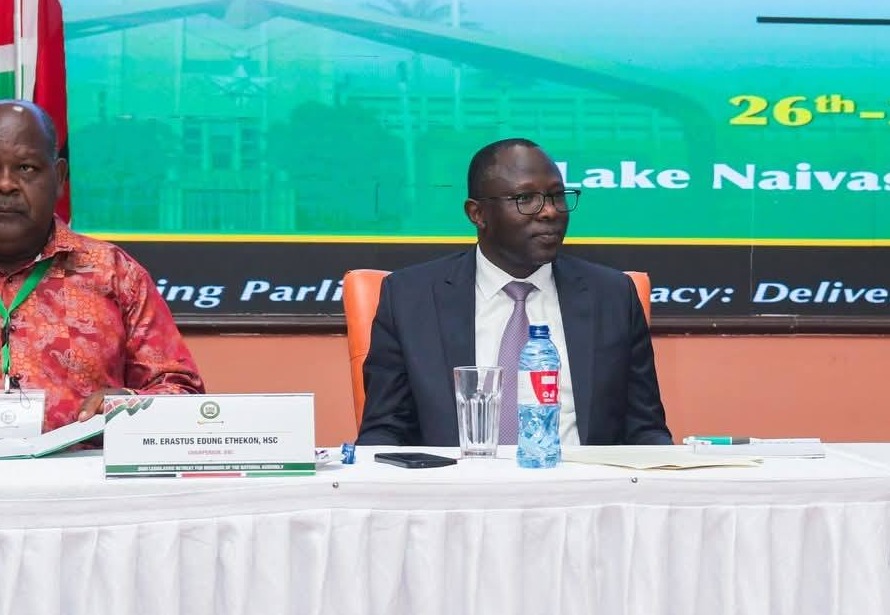
The Independent Electoral and Boundaries Commission convened political party leaders in Nairobi on Thursday, 19 November, to discuss preparations for Kenya’s 10 August 2027 general election. The meeting exposed a disagreement about what those talks were supposed to accomplish. The commission saw an opportunity to explain its preparations. Opposition leaders including Rigathi Gachagua, Kalonzo Musyoka and Edwin Sifuna wanted the commission to work through proposed changes to the way voters are registered, votes are counted and presidential results are verified. They left after concluding that the agenda did not deal with those demands.
That disagreement preceded the moment the cameras captured. Gachagua said the opposition had repeatedly sought technical talks and cited a letter dated 10 May. His account of previous correspondence does not establish what the commission agreed to or how it responded. At Thursday’s meeting, he proposed that a team led by former Chief Justice David Maraga work with the IEBC on an agenda before the principals returned. Nation’s video report places the departure after commissioner Alutalala Mukhwana invited the ruling coalition to speak. That explains when the delegation left. The objection Gachagua put on the record explains why its members said they were leaving.
IEBC chair Erastus Ethekon called the departure unfortunate and said the meeting was an opportunity for parties to hear what the commission was doing. He also warned that court cases could disrupt preparations. UDA chair Cecily Mbarire raised a separate complaint about order and access at the meeting, and Mukhwana apologised for the commotion. Later, speaking in Bokoli, Bungoma, President William Ruto portrayed the walkout as an attempt to blame the commission for a possible opposition defeat. That was a political reading of the episode. It did not answer the technical questions that brought the parties to the room.
What the opposition brought to the meeting
Ahead of the talks, the People’s Coalition on Electoral Reforms set out four demands. It wants a clean, independently verifiable voter register, an end to national presidential tallying at Bomas or an equivalent centre, a pilot for electronic voting by Kenyans abroad, and livestreaming of voting, counting and results announcements. The package condensed several months of advocacy. In September, Maraga’s coalition had already sought an independent register audit and the removal of the national centre, alongside changes to election technology, enforcement of election offences and scrutiny of IEBC recruitment.
The register. The demand has a factual history. In June 2022, the IEBC said a preliminary KPMG audit had flagged 246,465 records of deceased voters and 481,711 duplicate records, among other problems to address before certification. Those were findings about the register under review in 2022. They do not establish the state of the 2027 register or show that anyone cast a fraudulent ballot. A useful response now would give parties the next audit’s scope, who will carry it out, what findings will be published and how eligible voters can challenge an erroneous omission or transfer. Publication of aggregate findings and an accessible challenge process can help voters verify the register without exposing sensitive personal records.
The presidential tally. The opposition argues that constituency results should be final and that a national tallying centre creates a point at which figures could be interfered with. Its position on constituency finality has substantial support in law. Its proposal to abolish the national centre faces a different legal question. In a 22 September 2026 judgment on petitions brought by Okiya Omtatah and opposition figures including Kalonzo and Gachagua, the High Court upheld the statutory provisions for a national tally. It affirmed that the commission cannot alter certified constituency results. It also held that the IEBC collectively must aggregate and verify the figures against the constitutional thresholds. A candidate needs more than half the votes cast nationwide and at least 25 per cent in at least 24 counties.
The practical question is what agents and observers can see when the commission performs that national task. The court identified safeguards including access to real-time data, recorded collective decisions and public documentation of discrepancies. A demonstration of how the commission will apply those safeguards would give the parties something specific to test. A change of building would leave the same questions about who sees the figures, who records discrepancies and which documents govern the declaration.
Diaspora voting. Article 82 requires the progressive registration of citizens abroad and the progressive realisation of their right to vote. IEBC figures put diaspora registration in 2022 at about 10,400, with arrangements in 12 countries. Distance from registration and voting centres is a real barrier that Maraga’s remote-voting proposal seeks to address. An electronic pilot would need clear rules on eligibility, identity checks, ballot secrecy, independent testing and a way to audit a contested result. The commission can also explain what it could do within the current framework, such as expanding access to physical centres, while any change in voting method is assessed.
Livestreaming. Letting the public watch counting and the announcement of results could make the process easier to scrutinise. Streaming the act of voting raises different questions about secrecy and intimidation, and weak connectivity will make coverage uneven. The public needs the signed polling-station forms, a reliable results portal and a documented process for resolving discrepancies even where a camera or internet connection fails. Those records allow a party agent or observer to compare the result announced locally with the figure used nationally.
The technology dispute predates the walkout
In January, opposition leaders asked the IEBC to stop engaging Smartmatic, the supplier associated with the 2022 election. This week Gachagua said the existing contract expires on 24 November and asked how continuous registration would be protected during the transition. The expiry date is his reported account. Ethekon said before Thursday’s meeting that procurement was ongoing and no supplier had been selected. The ownership of election data, access to systems, independent testing and a contingency plan matter whichever company supplies the equipment. Publishing the timetable for procurement and the plan for keeping registration open would address a more immediate question than arguing over a vendor’s name.
Walking out drew attention to the opposition’s demands. It also meant the leaders who left did not stay to press for answers in the wider forum. A Maraga-led technical meeting could still be useful if the commission records the questions, says which ones it can decide under existing law, and identifies those that require Parliament to act. Other parties, observers and the public would have reason to expect access to the same answers.
The next test is whether there is a dated agenda, a written response to each proposal and a timetable for decisions. The IEBC can do that work while retaining its independence. Opposition leaders can then be judged on the safeguards they propose and the evidence they bring. Thursday established that the parties disagree about how to have the conversation. The documents produced after the walkout will show whether they can move on to the rules of the election itself.
Photo details
WHAT TO WATCH NEXT
- Whether the IEBC agrees to a dated technical meeting and responds to the four proposals in writing.
- Whether the commission publishes a register audit timetable and a plan for keeping voter registration open during procurement.