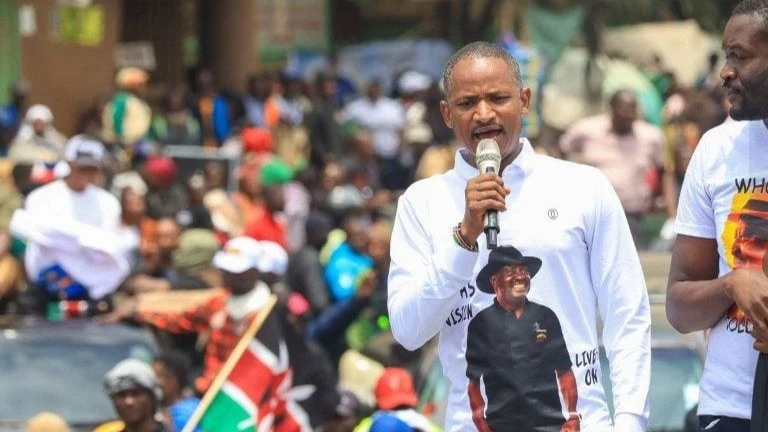
Embakasi East MP Babu Owino has turned complaints about Nairobi school meals into a political challenge to Governor Johnson Sakaja, promising to remove parents’ contributions and extend feeding to high schools if he wins the governorship. His intervention, reported on 2 October, brings together two distinct questions: whether particular meals met the required standard, and how a larger programme would be funded.
Tuko’s report of Babu’s Facebook statement says parents complained about poorly cooked chapatis. This newsroom has not independently authenticated the photographs, established which kitchens supplied the meals or obtained inspection findings. The complaints therefore remain allegations, rather than a confirmed food-safety finding against the county.
“No parent will pay a single shilling. The meals will be completely free,” Babu said in the statement reproduced by Tuko. That is an election pledge. It does not change the current programme or establish that money has been allocated to implement his proposal.
The county’s own record sets out the existing subsidy
The clearest baseline is Sakaja’s address to the county assembly on 11 February 2026. In the official Hansard, on page three, the governor reported daily meals for 323,470 learners in 230 early-childhood and public primary schools, with more than 72 million meals served cumulatively.
“Parents contribute five shillings per meal and the County subsidizes the rest,” Sakaja told the assembly. He said the most vulnerable ten per cent paid nothing. These are the governor’s recorded statements about programme coverage and funding at that time, not an independent audit of every meal or household.
The same address described 17 central kitchens and a partner Giga Kitchen. Sakaja said the county executive had approved a feeding policy in January and intended to increase the number of kitchens to 69. The distinction between operating kitchens and an intended expansion matters: the address did not say all 69 were already working.
Secondary-school expansion was already being discussed
Babu’s pledge is not the first proposal to extend feeding beyond primary schools. In an August report by The Star, Sakaja said the county was preparing to include public day secondary schools and other underserved learners.
The governor’s proposal and Babu’s promise should therefore be compared on their actual terms. Sakaja described a planned extension of an existing programme; Babu promised high-school coverage without a parental payment. Neither statement, by itself, demonstrates that the expanded service has reached every intended school.
The August account put cumulative provision at 85 million meals and daily coverage above 324,000 learners. Those figures concern different measures: one counts meals over time, while the other describes pupils served. They must not be added together or treated as an independently verified October total.
How chapatis entered the programme
Citizen’s August report on the Toi Primary Kitchen described the installation of a machine with a stated capacity of up to 2,000 chapatis an hour. Schools were to receive chapatis on designated days under a distribution timetable, rather than every school receiving them daily.
That background explains why photographs of chapatis have become politically significant. The equipment was promoted as an expansion of menu choice. Its stated production capacity, however, measures potential output; it does not establish the quality of a particular batch delivered to a classroom.
The programme also involves transport between kitchens and schools. A January Citizen account described preparation beginning at night, followed by distribution ahead of lunchtime. Identifying the school, service date and supplying kitchen would therefore be necessary to investigate an individual complaint reliably.
A campaign contest with practical consequences
The political difference is now clearer than a simple argument over whether children should be fed. Sakaja can point to an operating subsidised programme and recorded expansion plans. Babu is offering a different payment model and broader coverage. Comparing them requires delivery evidence as well as promises.
No specific county response to the October complaints was established in the sources reviewed for this article. Earlier statements describing the programme’s benefits are background, not a reply to those complaints. Nor does the absence of a response in these sources establish that the county refused to respond.
For readers following Political Headache’s accountability coverage, the immediate issues are identifiable: an investigation of the reported meals, a clear account of current coverage, and a funded plan behind any proposed expansion. The campaign claims are news; their delivery and the allegations about meal quality remain separate questions requiring evidence.
Photo details
WHAT TO WATCH NEXT
- Babu promises free meals while official county records show how Sakaja’s existing subsidy works.
- A county response to the meal-quality complaints and detailed funding for any proposal to remove parent charges.