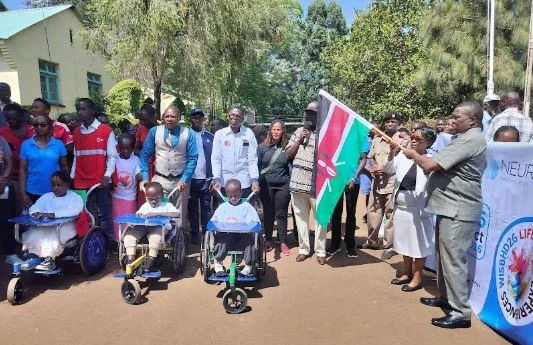
Health-sector representatives in Kisii have called for stronger follow-up services for children living with spina bifida and hydrocephalus, arguing that surgery must be followed by continuing care. The appeal came during the 25 October awareness-day event at Kisii Cultural Hall, where support for families and access to rehabilitation were central concerns.
According to Kenya News Agency's report, BethanyKids Country Director David Ng'ang'a said the gap often comes after the initial operation. The event also highlighted training for 30 health workers at Kisii Teaching and Referral Hospital and the donation of 58 specialised wheelchairs with support from BethanyKids and NeuroKids.
Those figures describe activities reported at the event. They do not establish the total number of children requiring services in Kisii or the proportion of local need that has been met. The broader issue raised by the speakers is continuity: whether a child and family can access appropriate support as needs change over time.
Why care can continue beyond surgery
The US National Institute of Child Health and Human Development's explanation of spina bifida care describes several kinds of need that can coexist. They include treatment for the spinal condition, management of associated hydrocephalus, mobility support and care relating to bladder and bowel function. The combination varies between individuals.
For hydrocephalus, the institute explains that a surgeon may place a shunt to drain excess fluid and reduce pressure. Such a device may need replacement during childhood. This illustrates why an initial procedure does not necessarily end a child's contact with specialist services. It is general medical background, not a diagnosis or treatment recommendation for any child at the Kisii event.
The institute also describes different forms of mobility support, ranging from walking without assistance to using braces, crutches, walkers or wheelchairs. A wheelchair donation therefore meets a particular kind of need; it should not be taken to mean that every person with spina bifida uses one or requires the same equipment.
Its account further identifies the importance of ongoing specialist review where urinary-tract problems are present. These needs help explain the emphasis on follow-up in Kisii. They concern a continuing relationship with healthcare professionals, rather than a single intervention that can be assumed to resolve every aspect of the condition.
Rehabilitation supports everyday participation
The World Health Organization's rehabilitation guidance describes care aimed at improving or maintaining a person's functioning. It can involve professional assessment, exercises or training, assistive products, changes to the surrounding environment and education. The approach depends on the individual's circumstances and goals.
WHO also explains that rehabilitation can take place in hospitals, specialist centres, clinics, schools and homes. That breadth matters to a family trying to connect clinical treatment with daily life. The useful outcome may include greater independence or participation in meaningful activities, rather than the end of all healthcare needs.
A programme is normally assessed and adjusted by the professionals involved. The number and type of sessions depend on the person. It would therefore be misleading to treat attendance at one outreach event, or receipt of equipment, as evidence that long-term rehabilitation is complete.
A local provider describes a range of services
BethanyKids' Kenya programme page lists paediatric surgery, physiotherapy, rehabilitation, assistive technology and mobile clinics among its activities. Its rehabilitation work includes wheelchair fitting, family education, community outreach and care associated with spina bifida and hydrocephalus. The organisation also identifies postoperative follow-up as part of its surgical work.
The provider's description helps explain the service model behind the appeal in Kisii. Surgery, fitting equipment and educating a caregiver are related activities, but each addresses a different part of care. Coordinating them can require several kinds of professional input rather than one appointment with one practitioner.
The page also lists training for surgeons, occupational therapists and wheelchair technicians. These are the organisation's stated programme activities, not a measure of staffing levels at every facility in Kisii. Establishing local availability would require information from the facilities and teams providing the services, including their current referral and follow-up arrangements.
From an awareness event to continuing access
For families, continuity involves knowing where follow-up is available and which service is responsible for the next stage. The Kisii report identifies training and equipment support, but it does not publish a countywide appointment system, waiting-time assessment or funding plan covering all future care. Those remain useful areas for further reporting.
The public-interest test is consequently broader than the number of items distributed on the day. It includes whether equipment is appropriate to the person, whether follow-up can be accessed and whether caregivers can obtain guidance as circumstances change. These are questions about the functioning of services, not grounds for assuming failure in every individual case.
The event has placed those questions before local health and disability stakeholders. Its central message is supported by the medical and rehabilitation background: care needs can extend well beyond an initial operation. The next evidence of progress will be in continuing access to the services families require, alongside the training and equipment initiatives already reported.
Photo details
WHAT TO WATCH NEXT
- Local follow-up arrangements.
- Implementation of the support described at the event.