
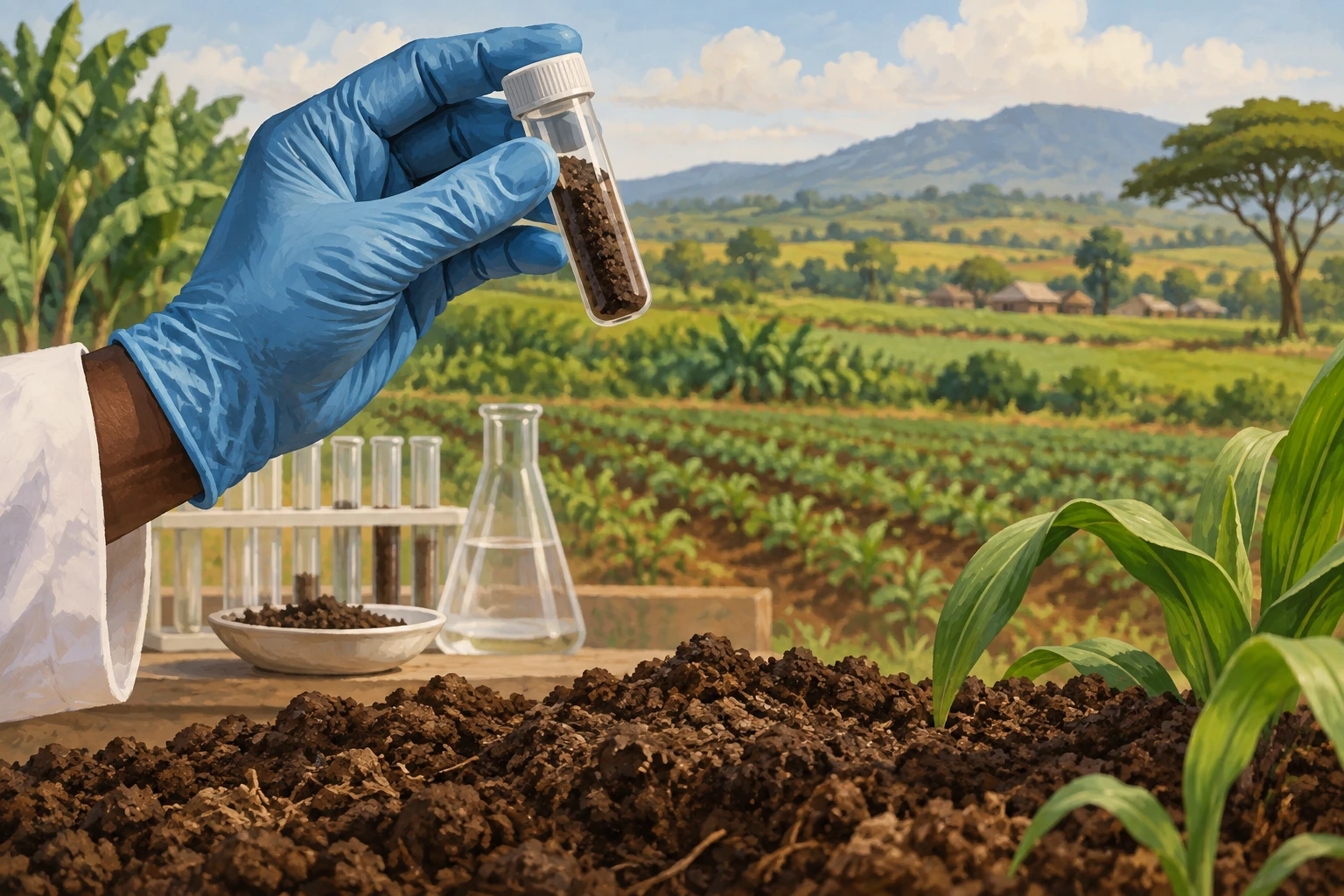
Kenya has launched a national soil partnership, a laboratory network and a wider farmer-training programme, opening a new test for agricultural policy: whether better information about land can change the advice and support that reaches farmers.
The initiatives were launched at KALRO’s Kabete facilities on 29 September. The Food and Agriculture Organization’s official account describes the work as part of SoilFER, undertaken with the Kenyan government and KALRO with support from the United States Department of State.
The launch included a renovated reference laboratory. FAO reports that the programme has collected 3,672 soil samples nationally and is testing recommendations at three research stations and in 50 on-farm trials. These are reported programme activities, not proof of a measured national increase in yields.
Why the information behind an input matters
Fertiliser policy is often discussed through the number of bags distributed, the price offered or the number of farmers reached. Those measures describe access and delivery. They do not, on their own, establish that a particular input matches the needs of the soil where it will be used.
The policy question is therefore broader than whether a consignment arrives. It includes how recommendations are developed, how local differences are recognised and whether farmers can obtain advice they can understand and afford to act on.
A useful information system should help decision-makers avoid treating every place as interchangeable. This does not mean that every farm requires a completely separate public programme. It means the reasoning behind a recommendation should be traceable to appropriate evidence rather than inferred from a national distribution total.
Three initiatives, three different jobs
The partnership is intended to coordinate institutions and other participants. The laboratory network concerns consistency and comparability of analysis. The Soil Doctors component focuses on bringing knowledge into farmer learning and extension. Their roles are related, but they are not identical.
That distinction helps frame accountability. A coordination meeting, a laboratory result and a farmer applying a practice are different stages. Counting one should not be used as evidence that all three have occurred.
For example, improved laboratory equipment can strengthen analytical capacity. Whether a farmer benefits also depends on how a sample reaches the laboratory, how results are explained and how any recommendation is followed up. The policy chain has several links, each with its own practical constraints.
Farmer-to-farmer learning is part of the design
FAO’s Global Soil Doctors programme description identifies it as a farmer-to-farmer training initiative. It is designed to help farmers understand soil degradation and share sustainable management knowledge, with support from extension services and other organisations.
The global programme began in 2020. Kenya’s latest launch should therefore not be reported as the invention of a completely new international scheme. The current development is the national rollout and its connection with the country’s wider soil-information work.
FAO’s earlier Kenyan training account also describes a planned connection to the Kenya Integrated Agricultural Management Information System. That provides background to the latest launch; it is not a newly announced feature on 1 October.
Local learning can make technical information easier to discuss. It still needs reliable support, clear limits and routes to specialist advice. A farmer trained to share knowledge should not be expected to substitute for every laboratory or professional service.
From a national sample to a local decision
A national sampling campaign can contribute to a broader picture, while field trials test how recommendations perform under particular conditions. Neither should be described as a guarantee for every individual holding. The scale and purpose of the evidence matter.
When publishing results, the responsible institutions should make clear the area represented, the date of collection and the limits of any recommendation. An understandable explanation would help users distinguish a general map from advice intended for a specific location.
The same principle applies to changes over time. A new dataset may improve the available picture without proving that every older recommendation was wrong. Careful communication should describe what the new evidence adds and which decisions it can reasonably support.
The public-service test after the launch
Several practical measures would help show whether the initiative is working. These include the time taken to process a sample, the accessibility of the result, the cost to the user and the availability of follow-up assistance. Each is closer to the farmer’s experience than a launch attendance figure.
The financing question is equally important. Equipment needs maintenance, analytical work needs skilled staff and training needs continuity. A programme should explain how these functions are sustained beyond an initial project period, without assuming that a renovated building is sufficient on its own.
Follow Political Headache’s county coverage for the local service-delivery context. For this programme, the county-level question is how national research capacity connects with extension work and becomes usable information at the point where a farmer makes a decision.
The Kabete launch establishes a promising set of institutional arrangements and reported research activities. The next evidence should show how the information travels, who can access it and what changes in practice. That is the basis for judging a soil-policy investment beyond the ceremony, while avoiding claims of success that the available record does not yet demonstrate.
Photo details
WHAT TO WATCH NEXT
- FAO reports the launch of a national partnership, laboratory network and Soil Doctors rollout on 29 September.
- Research activities and training targets are not evidence of a measured national yield increase.